MOTIVATION BEHIND MY SUBMISSION TO THE AUSTRALIAN NATIONAL AUDIT OFFICE
- In 2024, the Australian National Audit Office (ANAO) called for public submissions into whether Sport Integrity Australia had established fit-for-purpose governance arrangements.
- As ASADA changed its name to Sport Integrity Australia (SIA) on 1 July 2020, and as I had irrefutable proof that ASADA was corrupt and had breached Section 317 of the Crimes Act on scores and scores of occasions during the Essendon Saga, I believed SIA had to rebuild the organisation from the ground up. To that end, I made five submissions to the ANAO. The main submission contained 158 pages.
- For ease of reading on this website, I have broken up my main ANAO submission into individual stand-alone chapters viz:
- Background; Executive Summary; The process for catching athletes administered prohibited substances; ASADA/AFL Joint Investigation; ADRVP 3 November 2014 meeting; Dissection of ASADA’s presentation to ADRVP; Tampering with the evidence; Fabrication; Omitting evidence; Leading the witness; Freedom of Information requests; Examples of FOI requests with inadequate ASADA/SIA responses; Redactions; Misrepresentation of players’ evidence; Confidentiality; Damaging selective leaks; Staffer 7; Ben McDevitt ASADA CEO 2014-2017; Aurora Andruska; Staffer 5; Court of Arbitration for Sport; Conclusion.
- The submission was based on the fact that there was irrefutable proof that ASADA was corrupt and had breached Section 317 of the Crimes Act on scores and scores of occasions during the 2013-2015 Essendon Football Club ASADA/Australian Football League (AFL) investigation/prosecutions.
- Incomprehensively, Sport Integrity Australia’s chief executive David Sharpe did not even acknowledge receipt of over 20 lengthy emails informing him of the corruption. A fact confirmed by an FOI 21-2 request and SIA response. Furthermore, Sharpe ignored damaging evidence when the Herald Sun (16 October 2019) published irrefutable proof of ASADA’s corruption.
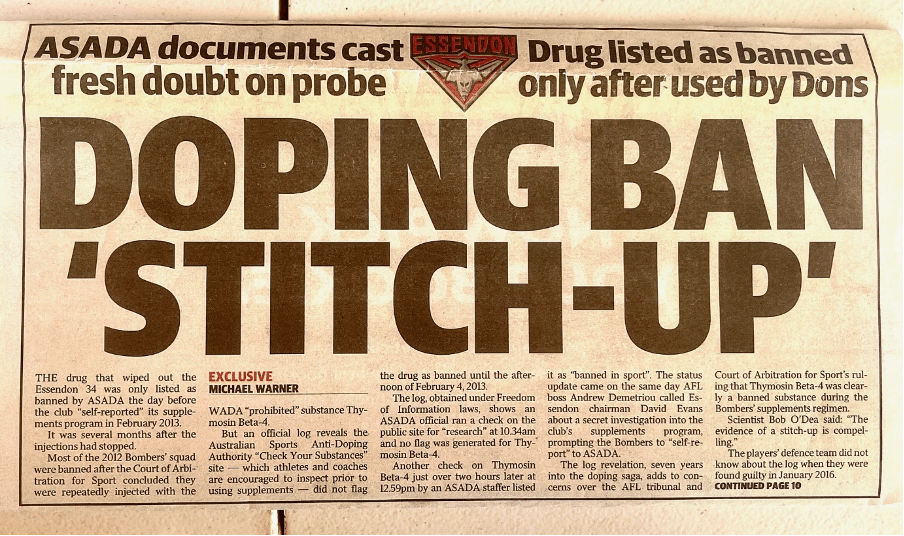
Herald Sun front page 16 October 2019, revealing Thymosin Beta-4 status was unlawfully changed on 4 February 2013. SIA CEO David Sharpe ignored the irrefutable proof that ASADA had acted unlawfully. It continues on page 12.
7. There were unprecedented governance failures during the investigation/prosecutions that ANAO was obliged to address because Sport Integrity Australia was operating under the same inadequate governance and supervision as ASADA. The submission identified criminal activities (tampering with the evidence) by the administration of ASADA/SIA that resulted in 34 Essendon players’ lives being destroyed.8.
8. Furthermore, if the ANAO agrees with my findings, and the Herald Sun’s findings of 16 October 2019, it should provide the foundation for the government and SIA to approach the World Anti-Doping Agency (WADA) to correct the greatest injustice in the history of Australian sport – the unjust prosecution and guilty findings against 34 Essendon players. Failure to act will not only mean that SIA has major endemic governance issues but will also mean that the ANAO condones the corruption. ANAO can’t claim to be for justice and then walk past injustice. ANAO is the standard it walks past.
9. Attacks on the Chinese and Russian governments and organisations notwithstanding, there has been little or no focus throughout the world on officials and their responsibilities, performances and corrupt actions.
10. The cause of finding and punishing those who seek to cheat at sport by using prohibited substances is a noble one. Clean athletes need to know they are competing on an even playing field. Athletes who cheat need to be discovered and prevented from taking part in their sport.
11. Clean athletes also need to know that those responsible for discovering and punishing the cheats do so to the highest levels of integrity. That is, they share in the absolute commitment to fair play they demand of the athletes. Consequently, clean athletes deserve protection from ‘dirty’ athletes and clean athletes deserve protection from ‘dirty’ officials.
12. Sadly, that is not the case. According to one of the finest swimmers of all time, Katie Ledecky, trust in the anti-doping process is the lowest it has ever been. That is a potent and telling observation.
13. A noble cause has been traduced by those in the anti-doping movement more committed to career advancement or personal aggrandisement, or by those compromised by the political and financial intrigues that all too often wreak their havoc on global sport.
14. The Australian Sport Anti-Doping Authority (ASADA) whose name changed to Sport Integrity Australia (SIA) on 1 July 2020, has not been immune to that. On the contrary, it has all too often and willingly allowed all of those elements to permeate the way it has sought to go about its business. This has been to the detriment of both individual athletes who have been unfairly treated, and to the collective work of seeking out and eliminating the real cheats.
 Essendon AFL Drug Saga